
A house project, whether it involves new construction or renovation, relies on a sequence of technical decisions where the order is as important as the content. Successfully completing house projects requires mastering a few fundamentals before starting any work: the thermal performance of the building, the current regulatory framework, and the consistency between the projected budget and the actual work undertaken.
Summer comfort and bioclimatic design: the criterion that plans often overlook
Most available advice focuses on room layout, solar orientation for winter heating, or living space. Summer comfort remains a frequent blind spot in house design.
Construction professionals now incorporate protection against heatwaves as a full-fledged design parameter. This includes shading exposed facades, cross-ventilation at night, and choosing materials with high thermal inertia (concrete, rammed earth, stone) that absorb heat during the day and release it at night.
Designing a house plan without simulating summer thermal behavior is like solving half the problem. A home that performs well in winter but is unlivable in July incurs extra air conditioning costs and a rapid decline in living comfort.
To delve into each step of your work and compare solutions tailored to your situation, Habiz resources cover both construction and renovation.

RE2020 and energy renovation: the regulatory framework that conditions your choices
Any new house project must anticipate the gradual strengthening of RE2020. This environmental regulation imposes energy performance and carbon emission thresholds that become stricter in stages. Ignoring these thresholds during the design phase exposes one to compliance costs once the work has begun.
In renovation, the landscape has changed significantly. The MaPrimeRénov’ “by gesture” pathway no longer covers most insulation done alone, nor ventilation, nor wood heating appliances. It remains open to certain heat pumps, the removal of an oil tank, and connection to a heat network.
Extensive renovation and heating replacement
An assisted extensive renovation can no longer retain gas or oil heating. This constraint radically changes the decision order: the replacement of heating must be integrated from the energy audit, not after the insulation work.
Specifically, a homeowner planning to insulate walls and roofing must simultaneously budget for switching to a heat pump or another compatible system. Separating these items risks losing eligibility for aid or having to redo part of the work.
- Conduct an energy audit before defining the work program to identify the applicable regulatory constraints for your home.
- Integrate the heating item into the overall budget from the design phase, not as an afterthought.
- Check the eligibility of each action for existing aid programs before signing a quote, as conditions frequently change.
Work budget: separating actual cost from displayed cost
The budget for a house project rarely goes off track with the major work. Cost overruns come from items that the initial estimate underestimates or omits: connections to networks, soil studies, adapting foundations to the slope of the land, and mechanical ventilation compliant with RE2020 requirements.
A reliable budget includes preliminary studies as full items, not as ancillary costs. The soil study (geotechnical study G2) conditions the type of foundations. The nature of the land can cause the cost of foundations to vary widely.
Balancing between the envelope and finishes
When the budget tightens, the temptation is to cut back on insulation or ventilation to preserve visible finishes. This is a poor choice. The thermal envelope and ventilation determine comfort throughout the building’s lifespan, whereas a kitchen or bathroom can be replaced in a few years.
It is better to deliver a house with simple finishes and a high-performance envelope than the opposite. Second work can be scheduled in successive phases, while redoing inadequate insulation after delivery costs much more than planning it correctly from the start.
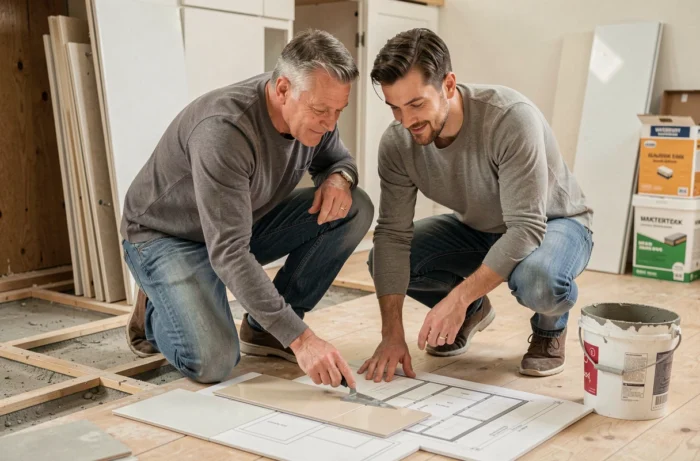
Ventilation and air tightness: two technical areas often undersized
A well-insulated house but poorly ventilated accumulates moisture, degrades indoor air quality, and encourages mold. Ventilation is not an accessory to comfort; it is a structural component of energy performance.
RE2020 requires an air tightness test at the end of the construction for new buildings. This test measures unwanted air leaks in the building envelope. A poor result negates some of the benefits of insulation and may compromise regulatory compliance.
- Plan the ventilation network (simple or double flow VMC) from the design phase so that ducts integrate seamlessly into the structure.
- Address specific air tightness points (junctions between walls and joinery, duct passages, access hatch to the attic) during construction, not afterward.
- Have the air tightness test conducted by an independent operator from the builder to ensure the objectivity of the result.
The quality of indoor air and the control of energy consumption directly depend on these two areas. Neglecting them during the design phase means accepting to live in a home that deteriorates faster than it should.
A successful house project is not just about a beautiful plan or a seemingly controlled budget. The strength of a project lies in the coherence between technical choices, the regulatory framework, and the hierarchy of priorities. Summer comfort, ventilation, and air tightness remain the three most frequent blind spots, and the most costly to correct afterward.