
In 2022, a team of researchers proved that certain word puzzles, previously considered unsolvable by a machine, could be solved in a matter of seconds thanks to machine learning. Yet, the majority of artificial intelligences still struggle to guess low-frequency words or to understand implicit rules designed to confuse experienced players.
Specialized platforms now integrate algorithms capable of analyzing habits, adapting difficulty, and offering new challenges, thus altering the boundary between human competition and automated performance.
When word games team up with artificial intelligence: a playful and cerebral revolution
Word games, powered by artificial intelligence, are disrupting habits and inviting enthusiasts to explore new playful territories. In Paris, research groups linked to the CNRS are developing advanced linguistic models, such as word2vec or word2vec glove. These tools, designed to capture the semantics of a word in games like Cementix, are refined through data collected anonymously from a large audience of players. With each game, these models gain in precision and efficiency.
In this unprecedented setting, the game is no longer limited to the confrontation between humans. Artificial intelligence, with its natural language processing, now offers personalized challenges, modulating difficulty according to each player’s journey. Platforms leverage the power of models to generate original grids, analyze participants’ strategies, and adjust challenges in real time. French expertise, fueled by its laboratories and engineers, holds a prominent place in this transformation, both in fundamental research and in the field of concrete innovation.
The repercussions of these advancements extend far beyond the playful realm. Progress made in artificial intelligence resonates in education, linguistics, and even finance. Some puzzle enthusiasts even draw on these techniques to share their own optimization methods. For example, consider this tip for the first month APL, which is inspired by strategies developed in automated data processing. This intersection of disciplines creates an ecosystem where curiosity, competition, and innovation intertwine.
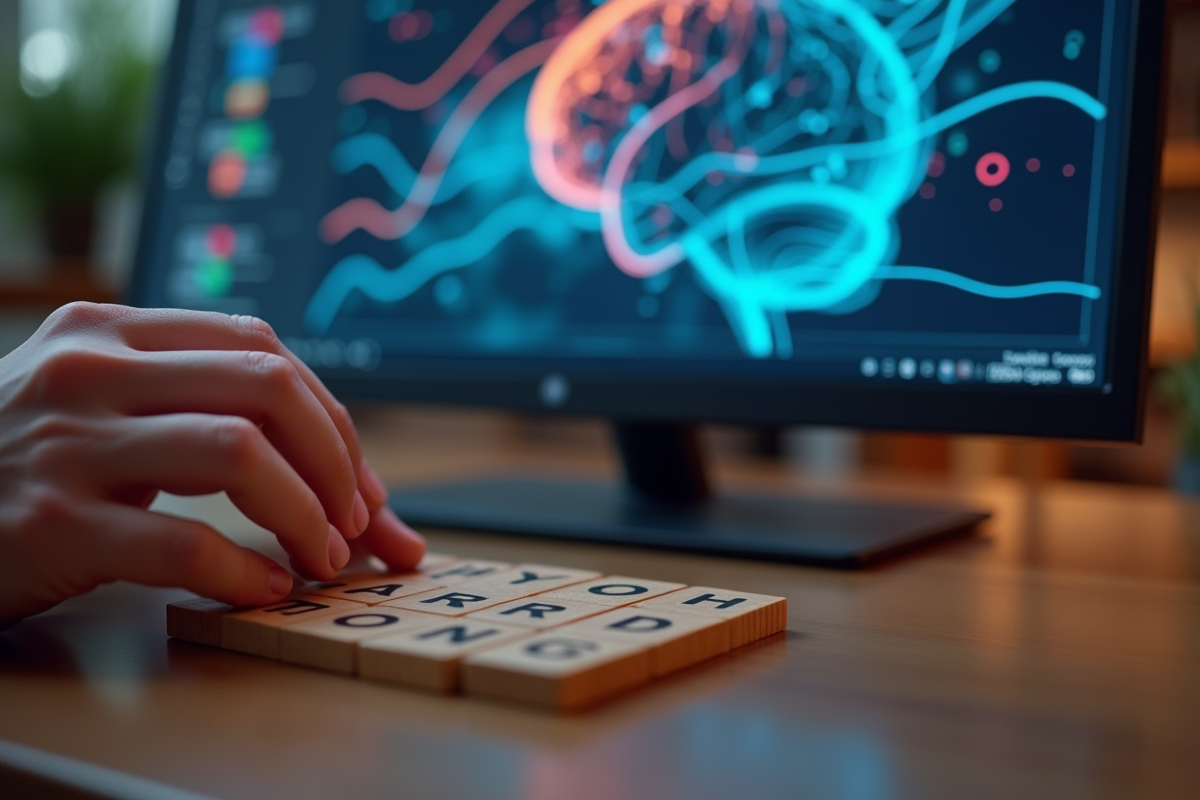
What challenges and opportunities does AI bring to puzzle enthusiasts?
The emergence of algorithms in the world of puzzle games is shaking up the benchmarks. Thanks to semantic proximity, these systems no longer merely validate an answer: they interpret, decrypt, and anticipate the logic of the puzzles. Platforms, based on data from thousands of games, refine difficulty and adjust challenges to each player’s profile.
Some challenges raised:
Here are a few points that question or stimulate reflection around these developments:
- The transparency of the search engines integrated into games, which raises questions of trust and fairness.
- The influence of the semantic memory of AIs on human creativity: the ability to preserve personal expression in the face of computational power.
- The issue of protecting personal data and its use in the continuous evolution of algorithms.
Despite these questions, these tools offer real prospects. Puzzle enthusiasts find in AI a partner as stimulating as it is formidable, ready to imagine surprising grids or decipher each player’s strategy. Human creativity intertwines with the logic of algorithms, giving rise to unprecedented interactive experiences. The line separating human and machine is blurring, paving the way for forms of entertainment previously unexplored.
Digital communities, gathered around daily challenges or themed tournaments, see their dynamics evolve. On social media, discussions about the subtleties of learning engines or the notion of semantic distance enrich debates and shape a new collective relationship with language.
The game has not finished reinventing itself as artificial intelligence joins the fray. Between curiosity, competition, and a thirst for innovation, a whole field of experimentation opens up for those who love to challenge words, and now, machines.