
You open your wardrobe, you look at the pile of clothes, and nothing goes together. The problem isn’t the number of pieces, but their coherence. Building a stylish wardrobe requires fewer impulsive purchases and more method, starting with what you actually wear every day.
Cost per wear: the calculation that changes fashion purchases
Before discussing trends, we talk budget. A garment worn twice is expensive, even on sale. A garment worn fifty times becomes cost-effective, even if bought at full price. This reasoning based on cost per wear transforms the way you fill your wardrobe.
Specifically, you divide the purchase price by the estimated number of wears. A pair of raw jeans at 90 euros worn three times a week for two years costs just a few cents per wear. A trendy dress at 40 euros worn only once for an event costs forty times more per wear.
This calculation encourages investing in pieces you throw on without thinking and limits purchases of overly specific items. When exploring fashion shopping with My Fashion Mag, you quickly spot which categories of clothing adhere to this logic and which are impulse buys.
Second-hand complicates this calculation slightly. Refashion has shown that the average price of a second-hand item is close to that of a new entry-level item. Second-hand does not automatically mean a good deal: you need to compare the actual condition of the piece, its material, and its durability before concluding that the price is advantageous.

Building a wardrobe with versatile basics
Trends come and go, but basics remain. Starting with a foundation of neutral and versatile pieces allows you to absorb any seasonal trend without having to buy everything new.
Pieces that work with everything
- A pair of straight or slightly tapered raw jeans: they can be worn with sneakers, ankle boots, or flats without any coordination effort. The raw color ages better than faded versions.
- A pair of fluid fabric pants, black or navy: they replace jeans when the dress code steps up from the office to dinner.
- A thick cotton t-shirt, white or off-white: worn alone, under a jacket, or tucked into a skirt, it serves as the base for most outfits.
- A structured jacket (blazer, denim jacket, thick overshirt): this piece transforms a basic look into a polished outfit.
With these four categories covered, you already have several dozen combinations. Four well-chosen basics generate more outfits than twenty poorly matched trendy pieces.
Colors: starting from a limited palette
We often hear that you need to “find your color.” The practical advice is simpler: choose three base shades (one dark, one light neutral, one medium) and one or two accent colors that appear in accessories or tops.
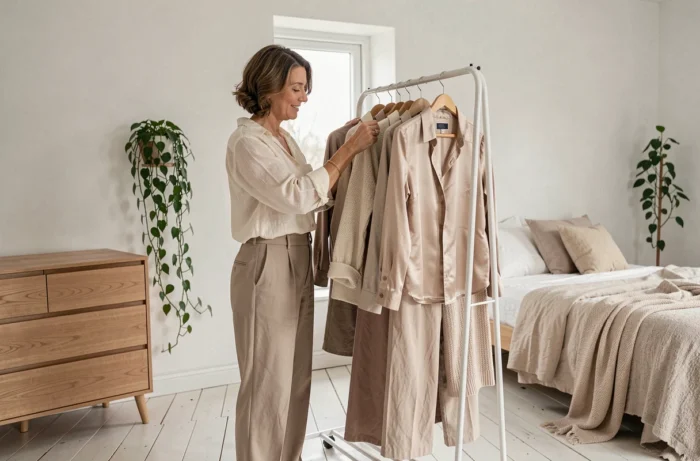
This system avoids orphaned garments, those that you never wear because they don’t go with anything else in the wardrobe. When adding a trendy piece (a sage green, a lavender), you check that it pairs with at least two basics already present in the wardrobe.
Current fashion trends: what deserves a place in the wardrobe
Following trends doesn’t mean buying everything. You select one or two pieces per season, those that extend what you already wear.
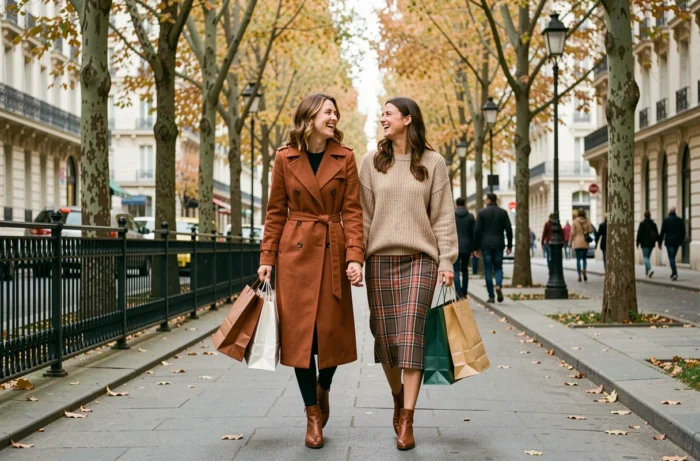
Current silhouettes play with volume. Loose cuts (Bermuda shorts, wide pants, long skirts) dominate the lower body, while tops remain fitted or semi-fitted to balance the silhouette. A common mistake is layering loose on loose, which flattens the silhouette instead of structuring it.
Natural materials are making a strong comeback in collections: linen, thick cotton, blended wool. This return coincides with a growing attention to the composition of garments. Checking the composition label helps decide between two similar pieces at the time of purchase.
For colors, earthy tones and muted pastels remain present, but saturated colors (bright red, cobalt blue) also mark the season. You integrate these strong colors in small touches (a bag, a scarf, a top) rather than on a statement piece that you might find boring in a few weeks.
Second-hand and purchasing channels: varying sources for better buying
The second-hand market has grown in volume between 2024 and 2025, faster than new according to Refashion data. The strongest dynamic comes from brands that offer their own second-hand section, more than exchanges between individuals.
For a coherent wardrobe, diversifying your purchasing channels yields better results than searching for everything in the same place:
- Peer-to-peer platforms are suitable for identified brand pieces, where you already know the cut and size.
- Charity shops (Emmaus, Red Cross) sometimes offer finds on basics in wool or cotton, provided you dig.
- Second-hand sections integrated into stores guarantee stricter quality control and facilitate returns.
The variable that changes from one channel to another is the reliability of the garment’s condition: on a peer-to-peer app, photos do not always show pilling or wear on seams. In physical stores, you can touch the fabric and check the finishes before paying.
Wardrobe sorting: the concrete method to keep only the useful
Buying better is useless if the wardrobe is overflowing with unworn pieces. Regular sorting (twice a year, at the change of seasons) keeps the wardrobe readable and combinations visible.
The practical rule is straightforward: any garment not worn in a year should be removed from the wardrobe. Not into a box in the attic, but for donation, resale, or recycling. Keeping “just in case” hides the pieces you actually wear behind those you never touch.
Once sorting is done, organize by category (tops, bottoms, jackets, dresses) and by color within each category. This classification makes associations visible at a glance and reduces the time spent searching for what to wear in the morning.
A stylish wardrobe is not one that contains the most clothes. It is one where each piece has its place, its reason for being, and at least three ways to be worn with the rest.