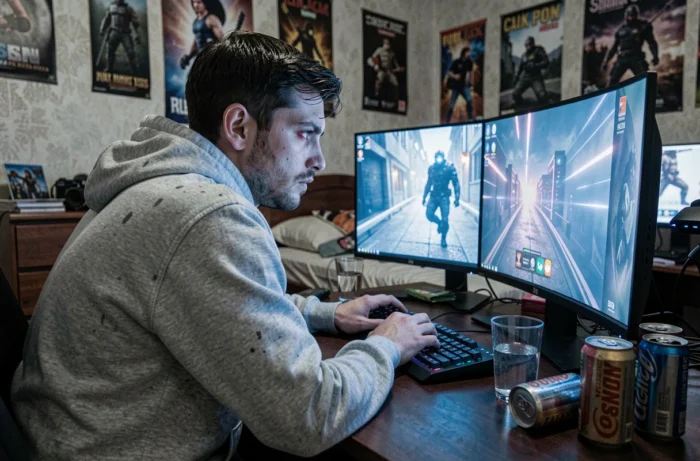
Insomnia in regular gamers rarely stems from a single issue. Managing video game-related insomnia first requires making the right diagnosis: going to bed late is not always insomnia, and blue light is not always the main culprit. Here, we detail the technical levers often overlooked by mainstream guides.
Insomnia or delayed sleep phase syndrome: diagnose before acting
A player who falls asleep at 3 AM and sleeps well until 11 AM does not suffer from insomnia. They exhibit a circadian rhythm delay, common among teenagers and young adults. The distinction is crucial: traditional advice (cutting screens, herbal tea, meditation) has almost no effect on an established phase delay.
The phase delay is characterized by normal quality sleep when the wake-up time is pushed back. If the person sleeps poorly even when going to bed late, we shift towards true insomnia. Therapeutic approaches differ radically between the two cases.
For phase delay, chronotherapy (gradually advancing the bedtime) and exposure to bright light in the morning yield better results than screen restriction alone. We recommend keeping a sleep diary for two weeks before making any habit changes, noting bedtime, estimated sleep onset time, nighttime awakenings, and wake-up time. This record allows a doctor to differentiate between insomnia, phase delay, and simple sleep debt.
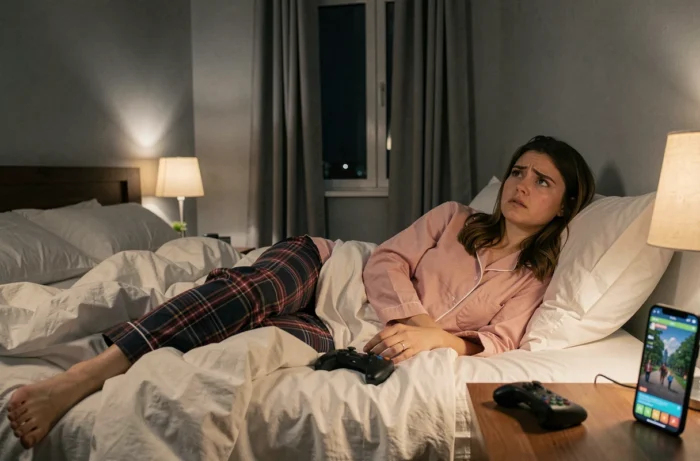
Cognitive Behavioral Therapy for Insomnia (CBT-I) and video games: the reference treatment for gamers
Cognitive Behavioral Therapy for Insomnia (CBT-I) is the first-line treatment recommended before any prescription of sleeping pills. It relies on techniques for restricting time spent in bed, stimulus control, and cognitive restructuring. Validated online programs now exist, making access easier for gamers accustomed to digital interfaces.
The principle of sleep restriction may seem counterintuitive: you temporarily reduce the time window in bed to increase sleep pressure and consolidate nights. A player who spends nine hours in bed but only sleeps six will start by staying in bed for only six hours, then gradually widen the window.
Stimulus control imposes a strict rule: the bed is only for sleeping. Playing in bed on a laptop or handheld console directly undermines this mechanism. Specialized resources compiled on insomniedugeek.fr detail how to adapt these protocols to the daily life of a regular gamer.
Restructuring beliefs about sleep
Many gamers harbor anxiety-inducing thoughts: “if I don’t sleep eight hours, I’ll miss my ranked games tomorrow.” This performance anxiety related to sleep exacerbates insomnia. CBT-I specifically works on these patterns by replacing rigid beliefs with more nuanced assessments of individual sleep needs.
Blue light and software filters: what science really says
Blue light filters (f.lux, Night Shift, Windows night mode) have become a reflex. Their actual effectiveness on falling asleep remains modest. Simply eliminating blue light does not correct established insomnia. These tools affect melatonin secretion, but the cognitive excitement caused by competitive gameplay is a far more powerful factor in delaying sleep onset.
The dopaminergic stimulation from an intense competitive gaming session keeps the nervous system alert. Even with an active filter, finishing a stressful ranked session at midnight leaves cortisol elevated for one to two hours. The blue filter does not solve this problem.
- Activating a blue light filter remains useful, but as a complement rather than a standalone solution. The effect is most noticeable when light exposure is passive (web browsing, videos).
- Reducing the overall screen brightness has a comparable, if not greater, impact than a simple color filter. Lowering brightness to one-third of the maximum in the evening decreases total retinal stimulation.
- Favoring slow-paced games (management, puzzle, narrative) during the last hour of gaming reduces physiological activation much more effectively than a color temperature change.
Measuring gaming performance after a bad night: the pitfalls of perception
A 2024 study on Rocket League esports players evaluated the effect of total sleep deprivation on gaming performance. The results suggest that a single match may not clearly reveal a drop in performance, advocating for monitoring over multiple sessions rather than a one-time assessment.
Subjective perception can be misleading. A tired player feels worse, but their statistics in a single game may not visibly drop. The degradation manifests over time: prolonged reaction times, repeated positioning errors, and impoverished decision-making after several consecutive short nights.
We recommend cross-referencing sleep data (duration, perceived quality) with game statistics over a period of at least two weeks. Several sleep trackers (smartwatches, apps) export usable data. Tracking trends over two weeks is better than relying on morning feelings.
When to consult a sleep specialist
If issues persist beyond three months despite corrected sleep hygiene, a specialized medical opinion is necessary. A sleep doctor can prescribe actigraphy or polysomnography to objectify the disorder. Sleeping pills are not a long-term treatment for chronic insomnia and carry a risk of dependence, especially in young adults.
Chronic insomnia in regular gamers is rarely managed with a single lever. Combining precise diagnosis, CBT-I, and session adjustments yields lasting results where isolated tips fail. Sleep is not an obstacle to gaming: it is a direct component of performance.