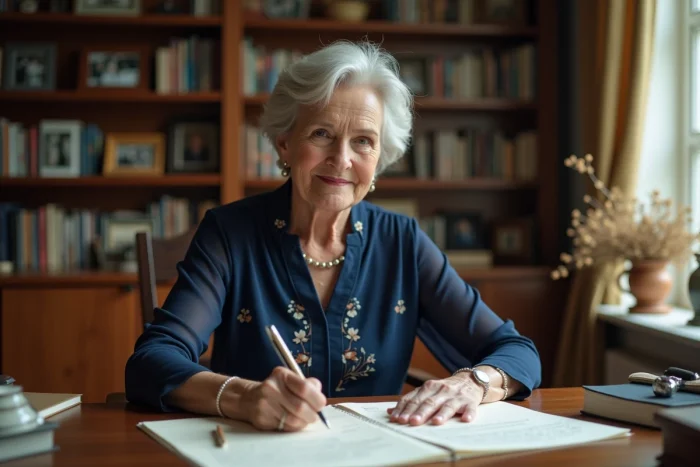
Writing a few lines for your son’s wedding seems simple, until the pen hovers above the card. An internal filter blocks: fear of being banal, fear of being too long, fear of crying before the end of the first sentence.
Finding the right words for your son’s wedding starts with accepting that a message gains in accuracy when it focuses on precision rather than grandeur.
Target a single emotion to avoid diluting the message
A parental text that mixes pride, nostalgia, humor, and wishes for happiness in one block ends up resembling an inventory. No feeling takes enough space to truly touch.
A word that resonates relies on a dominant emotion chosen beforehand. Pride in the journey accomplished, gratitude towards the person joining the family, or tenderness linked to a specific memory: choosing a unique thread gives coherence to each sentence.
When writing a poem or a note for your son’s wedding, this discipline prevents shifting from one register to another and allows the reader (or audience) to stay in the same emotion from beginning to end.
Are you hesitating between several feelings? Write them all down on a draft, then ask yourself which one tightens your throat when you read it aloud. That’s the one to keep.

Written note or oral speech: adapting the form to the wedding moment
A message slipped into an envelope in the morning and a speech delivered in front of a hundred guests are not written the same way. Confusing them produces either a text too literary to be spoken aloud or a card that sounds like a teleprompter.
The card or letter read privately
The intimate format allows for longer sentences, details that only your son will understand, and personal vocabulary. Three to five sentences are enough for a card message. A letter can extend to a handwritten page, but exceeding this volume dilutes the impact.
An effective card contains a specific memory (not a generic memory like “when you were little”), a named feeling, and a wish directed towards the couple.
The speech in front of guests
In oral form, the constraint changes: you need to be understood by people who do not share your family story. The anecdote must stand on its own in two sentences. The tone benefits from remaining conversational, as if you were speaking to your son while forgetting the microphone.
- Limit the speech to two or three minutes: beyond that, guests’ attention wanes, especially after the meal.
- Include a passage that addresses the daughter-in-law or partner directly, so that the message does not only concern the parent-son relationship.
- End with a short, affirmative sentence rather than a quote found on the Internet: the last sentence is the one everyone remembers.
Bilingual speech for a mixed wedding: an increasingly common case
When the couple is Franco-foreign, the groom’s parents face an additional challenge. Part of the assembly does not speak French, and the speech must include both families without becoming a simultaneous translation.
International wedding organizers note a growing trend to alternate languages in short blocks rather than translating sentence by sentence. For example, telling the anecdote in French, then expressing the wish for happiness in the language of the in-laws.
This format requires avoiding puns, idiomatic expressions, and overly local cultural references. A visual memory (a scene, a place, a gesture) communicates better than a linguistic quip, because the image is understood in all languages.
Pre-recording your message on video: an alternative to a live speech
In recent years, some parents have chosen to film their message in advance and broadcast it during the reception. This format suits parents who live far away, those who dread the emotion at the microphone, or blended families where public speaking can create tensions.
The video allows for re-recording until the right tone is achieved, which a live speech does not forgive. The message can also incorporate photos or clips from family films, adding a visual dimension absent from the classic speech.
However, the video removes interaction with the room. The gaze towards your son, the trembling voice, the spontaneous laughter of a guest: these elements disappear. If you choose this format, complement it with a handwritten note given in person on the day.
Blended families: include without erasing
In blended families, a stepparent, an absent parent, or a grandparent who played a central role complicates the speaking process. Standard speech models presuppose a nuclear family structure, and adapting them requires some concrete adjustments.
The simplest rule: name the people present without ignoring those who are absent. One sentence is enough to mention a deceased or distant parent, without turning the speech into a funeral tribute or a settling of scores.
- Address a distinct passage to the spouse or in-laws to mark the opening of the family circle.
- Avoid phrases like “his real father” or “like a son”: they hierarchize the bonds instead of recognizing them.
- If several parental figures wish to speak, divide the angles (a childhood memory for one, a wish for the other) rather than delivering two parallel speeches.
A short message, focused on a specific memory and also addressed to the couple being formed, is more likely to mark the day than a long speech constructed to impress. The draft that brings tears to your eyes is probably the right one.