Pietra d’Alba appears on many travel blogs as a Piedmontese village to discover among vineyards and hills. The problem is that this toponym does not appear in any official Italian cartographic reference. Neither OpenStreetMap, nor GeoNames, nor the municipal databases of Piedmont or Tuscany list it. Understanding this discrepancy between the SERP and the geographical reality helps to better prepare for a stay in the region that inspired this name.
Pietra d’Alba on maps: what Italian geographical references say
Pietra d’Alba does not exist in any official cartographic database. The regional tourism portals of Piedmont, including sections dedicated to the authentic borghi of the Langhe, Roero, and Monferrato, do not mention this name. Guides updated after 2023 confirm this absence.
The toponym comes from the novel by Jean-Baptiste Andrea, winner of the 2023 Prix Goncourt, who invented this village as a literary backdrop. Several travel sites then adopted the name to suggest real itineraries in northern Italy, without always indicating that it is a fictional place.
To locate the landscapes that correspond to the imagination of Pietra d’Alba, a map of Pietra d’Alba in Italy helps to identify the villages and hills of the Langhe that serve as the backdrop for this literary inspiration.
Langhe and Alba: the real terroir behind the fictional village
The city of Alba and the hills of the Langhe constitute the real terroir that the novel transposes under the name of Pietra d’Alba. Alba is the historical and gastronomic center of this area of Piedmont, known for its white truffle, IGP hazelnuts, and internationally renowned wines.
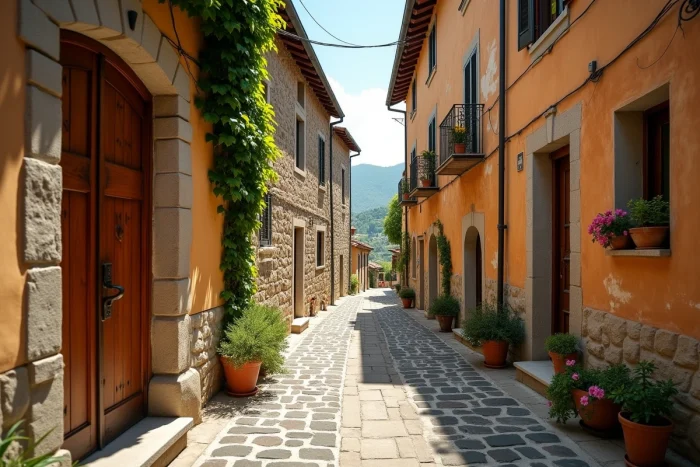
Several elements of the novel refer to precise geographical realities. The stone alleys, the viewpoints over the vineyards, the farmers’ markets: all of this can be found in the scattered villages around Alba.
Comparison between Pietra d’Alba and the real villages of the Langhe
| Criterion | Pietra d’Alba (fictional) | Villages of the Langhe (real) |
|---|---|---|
| Presence on maps | No official database | Listed by the municipalities of Piedmont |
| White truffle | Mentioned in online guides | International fair in Alba every autumn |
| Vineyards | Described as Barolo/Barbaresco | Well-defined Barolo and Barbaresco appellations |
| Stone architecture | Alleys and viewpoints mentioned | Classified medieval borghi (La Morra, Barolo, Serralunga) |
| Access from Turin | Not specified | About an hour and a half drive |
This table highlights a central point: everything attributed to Pietra d’Alba corresponds to visitable places in the Langhe. The difference lies solely in the status of the toponym.
White truffle, hazelnut, and wines of the Langhe: the terroir to explore
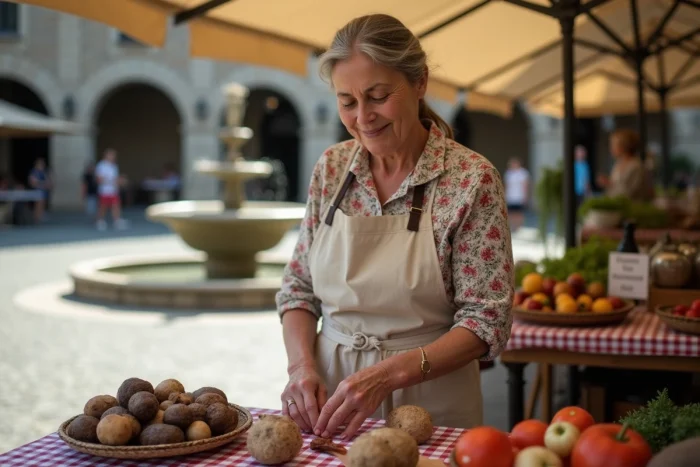
The white truffle of Alba remains the flagship product of the region. Its annual fair attracts visitors from around the world and structures the local tourist calendar. In contrast, the IGP hazelnut of Piedmont, less publicized, represents an equally rooted aspect of the terroir.
- The white truffle is harvested in autumn and enjoyed fresh, grated over tajarin (local egg pasta) or Piedmontese fondues
- The Tonda Gentile hazelnut has IGP status and is used in many regional pastries and confections
- The Barolo and Barbaresco wines, made from the nebbiolo grape, are among the most prestigious appellations in Italy
- Vitello tonnato and ravioli del plin complete a rich gastronomic menu, served in the osterie of the surrounding villages
The terroir of the Langhe is discovered village by village, each borgo having its producers, cellars, and specialties. Searching for “Pietra d’Alba” often leads to these same addresses, simply renamed.
Itinerary in the Langhe: three steps to find the backdrop of the novel
Rather than searching for a village that does not exist, it is more productive to build a route around the places that inspired Jean-Baptiste Andrea’s imagination. Three steps are enough to cover the essence of the landscape.
Alba and its historic center
Piazza Risorgimento, the medieval towers, and the San Lorenzo cathedral form the heart of the city. Alba concentrates Renaissance heritage and food market on a few pedestrian streets. The cellars in the center offer tastings of Barolo and Barbaresco without an appointment.
The hills between La Morra and Barolo
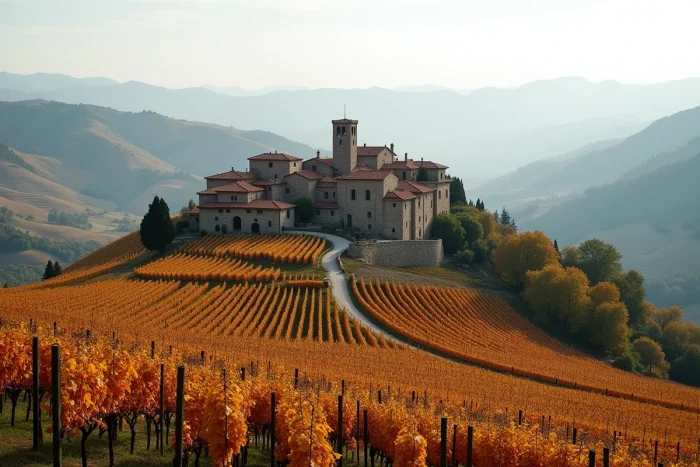
This stretch offers the panoramas closest to what the articles describe about Pietra d’Alba. Terraced vineyards, isolated chapels, winding roads lined with hazelnut trees. La Morra has a viewpoint that overlooks almost the entire Barolo appellation.
Serralunga d’Alba and its castle
The castle of Serralunga, with its atypical vertical silhouette, is one of the best-preserved in Piedmont. The village itself, a few dozen stone houses along a ridge, perfectly matches the image of the “authentic borgo” that guides attribute to Pietra d’Alba.
These three steps can be covered in one day from Alba, or in two days for those who wish to include visits to cellars and a meal in a village osteria.
Guide or map of Pietra d’Alba: how to filter information online
The majority of online content mixes fictional data and real information about Piedmont. To prepare for a stay, a few reflexes can help sort through it.
- Check if the mentioned village appears on an official map (Italian municipalities, OpenStreetMap) before planning a route
- Cross-reference restaurant or cellar addresses with booking sites or local directories
- Prefer regional guides of Piedmont that list the Langhe, Roero, and Monferrato by real municipalities
Articles that treat Pietra d’Alba as a real destination are not useless: they often describe authentic experiences (truffles, hiking in the hills, markets). The filter to apply concerns the exact location, not the quality of the recommendations.
Jean-Baptiste Andrea’s novel has given unexpected visibility to the Langhe among a Francophone audience. Pietra d’Alba serves as a literary gateway to a very real terroir, provided one knows that the map to consult is that of Alba and its hills, not that of an imaginary village.